
How participating in Spoonflower Design Challenges can boost your pattern designer career.
In 2025, I challenged myself to participate in every Spoonflower Design Challenge. I made it into the top 100 ten times. Now I want to share with you why I plan to continue participating in every challenge and what you can gain from doing it too.
No time to read the whole article? Jump to TL;DR!
I started selling my pattern designs on Spoonflower in the spring of 2024 without knowing much about what I was doing. If you don’t know Spoonflower: As a surface designer, you can upload your designs there and customers can buy them on wallpaper, fabric, and home decor. Spoonflower hosts a new design challenge every two weeks.
Disclaimer: I am not getting paid by Spoonflower for writing this post. I’m just sharing my own experience.
In the beginning, I only participated in those design challenges that fit my style and sounded enticing to me. However, at the beginning of 2025, I decided to participate in every challenge. Then at the end of the year, I could decide if I wanted to continue that approach. Spoiler: Yes, I will definitely continue this strategy in 2026. Why? Because it pays off!
So let’s dive into my list of seven reasons why I participate in every challenge.
7 Reasons to Participate in Spoonflower Design Challenges
Before we go through my reasons, I want to emphasize that these benefits will work for you even if you don’t place in the top 100! These are reasons that are independent of your placement. So even if you don’t make the placement you hoped for, you will still gain benefits just from participating in the challenge.
And of course, some of these reasons are applicable to other challenges too. There are many challenges out there. I also enjoy participating in challenges where I can learn and develop my skills, not only because there is a chance to win something.
1: Challenge Yourself!
I think this first reason is quite obvious, after all, it is called a challenge. If you only participate in the challenges that feel “like you”, then you’re going the safe route. But you’re not going outside your comfort zone. Through the design challenges, I have created patterns I usually never would have created! Which in turn helped me develop my style and skills further.
Let’s look at an example: In summer 2025, the challenge’s theme was “Toile with a Twist”. At first, I was like, oh no. I had never created a Toile de Jouy pattern before. But then I dove in and while I won’t pretend it was easy or fast (quite the opposite, actually), I created a design I was and still am very happy with. I learned a lot in the process, like typical motifs and layouts of Toile de Jouy designs — and also how to make a repeat in Photoshop, because up to that point I had only ever made my repeats in Illustrator.
This is my Toile de Berlin design. I was born in Berlin and still live here, so this is a tribute to my hometown. The design came in at place 89. Fun fact: I have hidden my husband and me in the design. Can you spot us?
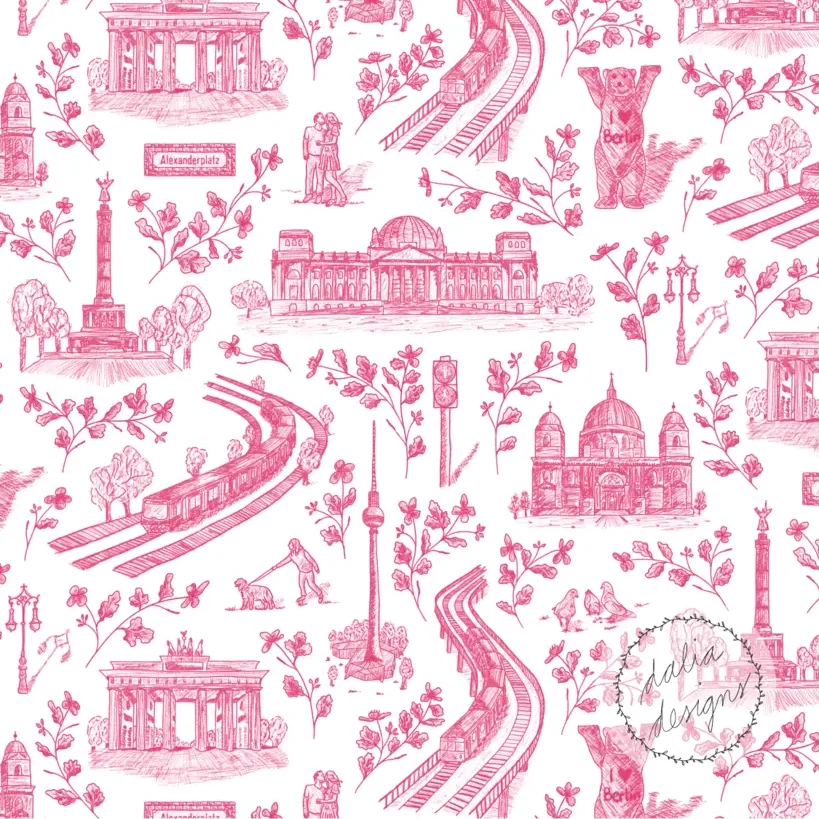
I think the challenge’s theme might have scared off a lot of artists, as there were fewer participants than usual. But that is an advantage because fewer participants = less competition.
2: Gain More Visibility for Your Designs!
This reason is also pretty obvious. A lot of people go through the submissions, so a lot of people will see your design. There’s both the other designers that participated, but also regular customers.
Since there are so many designs on Spoonflower, it can often be hard for your designs to be found. While there might be as many as 2,000 submissions in the popular challenges (anything floral is usually super popular!), a lot of people will still scroll through all submissions. And then the chances of them coming across your design is a lot higher than when regularly looking through designs on Spoonflower.
And then more visibility can turn into…
3: Generate More Sales Opportunities for Your Designs!
… more sales! The more people come across your design, the more likely it is that someone will buy it. Even after the challenges are over, people might scroll through past challenges so it’s not necessarily only a short-term effect.
That is one of the reasons why I try to always create at least three different color versions of a design. Three or more color versions of the same design are usually grouped together by the Spoonflower algorithm, so if someone clicks on one of your challenge designs and you have created multiple color versions, you also multiply your chances for a sale.
Sometimes, I might go back to a popular design and create even more color versions. The algorithm sometimes has difficulties grouping those together when they haven’t been made for sale at the same time, but I have had cases where it worked and I have actually sold more of the other color versions than the original version I submitted.
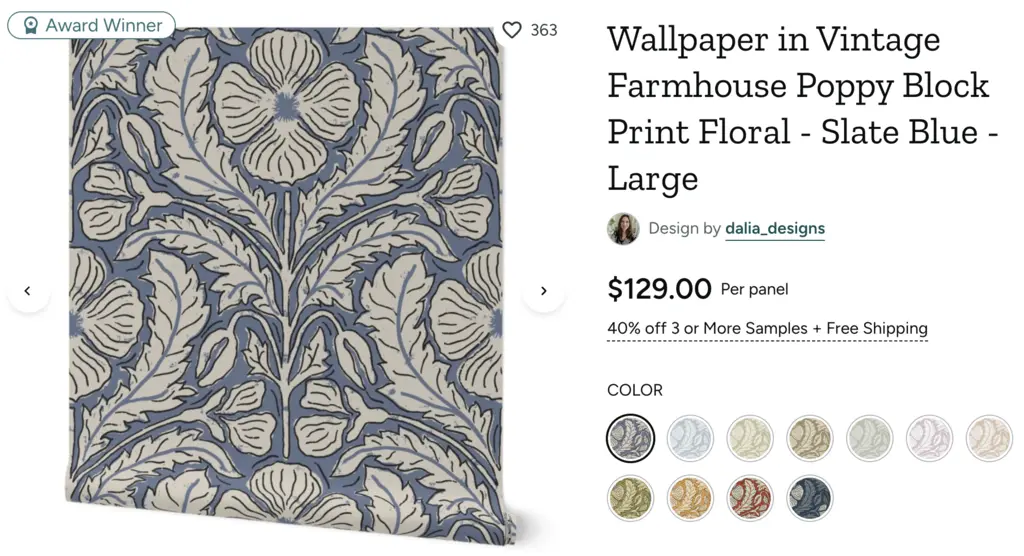
Bonus: If you make it into the top 100, Spoonflower will add a badge to your design that says “Award Winner” and you can also filter your search results on the page by award winners only. Of course, I don’t have the insights but I am pretty sure a lot of shoppers use that filter because a) it reduces the amount of search results, and b) “award winner” sounds impressive and carries the promise of great designs.
I’m pretty sure the Spoonflower marketing team also goes through the submissions. One of my designs, my Art Deco Peacock Mosaic, which came in at place 15 in the Art Deco Challenge, has since also been made available for sale on Spoonflower’s Etsy and Amazon Marketplace which in turn generated more sale opportunities for me. I’m convinced that it wouldn’t have happened if I hadn’t submitted this design to the challenge.
4: Expand Your Portfolio!
Creating new designs can help you expand your portfolio. If you only submit to the challenges that feel safe, you will not experiment with new styles and motifs. But if you do, you can diversify your portfolio!
Here’s a list of design styles/themes that I could only add to my portfolio because I participated in Spoonflower’s design challenges:
- Paisley — through the Novelty Paisley Challenge
- Block Print — through the Block Print Floal Challenge, and now it has become one of my favorite styles!
- Funny Cats — through the Pet Doodle Challenge, and now this design can also be bought on Fabric Bank (which ties back perfectly to reason 3)!
- Toile de Jouy — through the Toile with a Twist Challenge
- Architectural — through the Palm Springs Challenge
- Folk Animals — through the Festive Animals Challenge
- Cross-stitch Style — through the Thrift Store Treasures Challenge
- Delft Tiles — through the Delft Tiles Challenge
Quite a long list, isn’t it?! I was a bit surprised myself when I made the list for this blog post. Because of the challenges, I did a deep dive on all of these styles and themes and learned about layouts, motifs, and colors — and I never would have done so otherwise (to that extend).
Something that I am trying to do more often recently is to take the design that I submitted and turn it into a (mini) collection. In my case, most of the designs I submit are hero designs and creating two to five more designs around the same theme and motifs is not too much work.
Let’s take my Enchanted Garden design that I submitted to the Garden Tapestry Challenge. It came in at place 72 and I love the design’s theme: a whimsical garden, overgrown with rose vines, swings in trees, Victorian greenhouses, romantic gazebos, little lanterns… There is so much storytelling in that design! So I went back in and created five more supporting designs — and now I have my Enchanted Garden collection. I added vintage keys to the motifs; other than that I worked with the motifs that were already in the hero design.


5: Create Designs for Trending Topics!
Don’t enjoy chasing trends? Dread doing all the research about what is trending? I feel you, me too!
The Spoonflower challenge prompts take care of that! The themes are usually around trending topics so you have that covered. No researching about what is trending and then coming up with ideas. You get it all delivered to you by the prompt of the design challenge. Some of the prompts even come with suggested color palettes.
If you want to take it one step further, you can create different color versions of your submission that cover other styles or moods. Not sure what I mean? Here is another example:
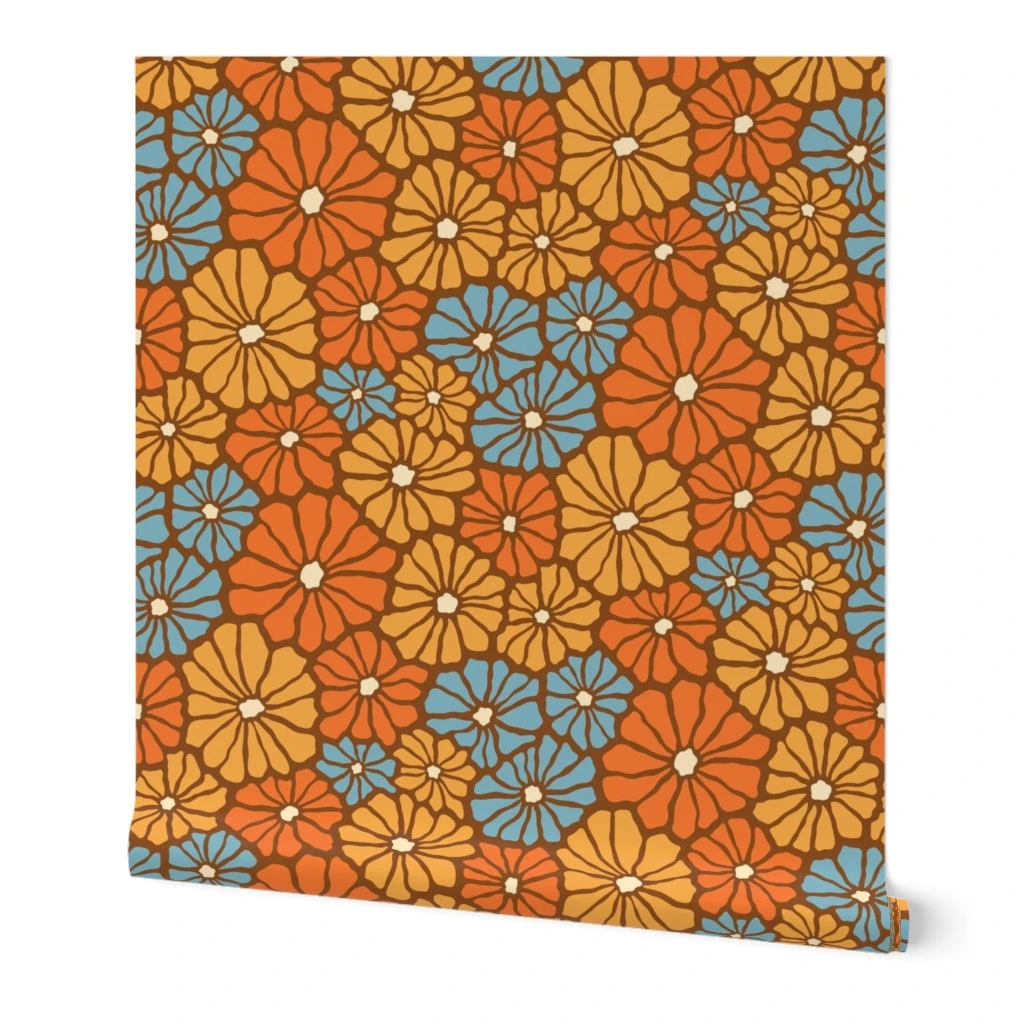
For the 1970s Challenge, I created a design featuring abstract, Matisse-inspired daisies. I submitted a version with yellow, orange, and blue flowers on a brown background, going all in on the 70s theme. But then I also created some pastel color versions and voilá! the same design suddenly has a nostalgic, y2k feel — which in itself is also a trending topic. Two birds with one stone!

6: Create SEO-Rich Designs!
Do you love to create floral patterns? Yes, me too! And so do so many others. So sometimes, it can be a bit difficult to find SEO-rich terms for these designs to make sure they can be found.
Usually, the Spoonflower Design Challenges make that part easier too. The themes are very versatile so you are also forced to create patterns with more versatile motifs. And these motifs automatically mean more search-friendly keywords for your designs.
And in most of the prompts, you can still incorporate florals somehow, if you want to. I often do!
7: Prevent Your Designs from Being De-Listed!
Yep, you heard right. Spoonflower can de-list designs under certain circumstances. You can read about all the details on their De-listing Designs FAQ so I will just briefly go over the main points.
If a design has no sales and less than 50 likes after two years, Spoonflower may de-list the design, meaning making it private and not for sale anymore. I have not yet reached the two year threshold with my Spoonflower shop, so I can’t report any personal experiences.
But! If you participate in a design challenge intentionally, it is quite likely you will get 50 likes or more. That means that design (and all its grouped color versions) is safe.
Soooo, I hope you enjoyed reading about the reasons why I find Spoonflower Design Challenges so helpful and feel motivated to participate, also — or especially — in the ones that appeal less to you at first glance.
Are you now curious how I managed to get into the top 100 ten times in 2025?
If I had to break it down to one word, it would be intention!
Yep, creating intentionally, with a goal in mind, that’s all. Sounds easier said than done, though, right? So I’ve got you covered: In this blog post, I am sharing the strategies with you that help me get into the top 100 more consistently.
You can check out all my top 100 placements here.
But keep in mind: A great placement doesn’t automatically guarantee sales. So don’t fret too much. Start with challenging yourself to more challenges (haha) and then go from there.
If you have any open questions about this post, post them below in the comment section or email me at hello@dalia-designs.com.
Brief Summary (TL;DR)
These are my reasons for participating in Spoonflower Design Challenges: challenging myself, gaining visibility, generating more sale opportunities, expanding my portfolio, creating around trends, creating SEO-rich designs, and preventing my designs from being delisted.



Leave a Reply